
Holocaust Memorial Day 2026 takes place on 27th January each year.
There are many different and meaningful ways you can get involved and play your part
This year's theme is:
Bridging Generations
Why We Must Carry the Torch of Remembrance
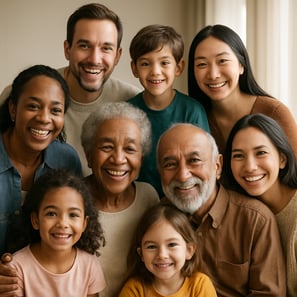
Memory fades.
Realities blur.
History becomes abstract.
As the years pass, we naturally grow more distant in time from the Holocaust and the subsequent genocides commemorated on Holocaust Memorial Day. However, that distance also brings a significant risk; it becomes vulnerable to being questioned or forgotten.
"Bridging Generations" addresses this head-on by highlighting the crucial role of the next generation in preserving these truths.
The Power of Dialogue
At its heart, the theme for Holocaust Memorial Day 2026 is about the power of connection.
It is about the:
- Listening to those who came before us and our commitment to sharing those stories with those who come after.
- Encouraging us to listen to survivors’ testimonies and pass those stories on to younger generations.
- Connecting the lessons of history to the present to ensure memory doesn't fade or become abstract
- Honouring both the survivors who are still with us and the "murdered generation" whose family lines were erased, ensuring their legacies live on through education and art
We therefore can do more than archive the past—we connect it to the present.
We build a bridge between memory and action, and between history and a hopeful future.
Honouring Every Legacy
Genocide does not discriminate by age. Infants, children, adults, and the elderly have all experienced unimaginable suffering. In many tragic cases, entire family lines were erased, leaving no one to carry the name forward.
"Bridging Generations" invites us to:
Honour each life lost.
Act as the "family" for those who left no bloodline.
Ensure legacies live on through books, films, art, and education.
We all must ensure that "Never Again" remains a promise kept by every generation.
How to Get Involved: Resources for Educators
The Holocaust Memorial Day Trust (HMDT) provides free, downloadable resources containing everything necessary to get involved with HMD, even for those new to teaching the subject.
Educational Support
The HMD education guidelines for teachers offer a comprehensive starting point for planning school-wide activities. Marking HMD in schools has a significant impact on young people, a result demonstrated through various local activity case studies. These resources are specifically designed to help students:
-
Learn more about the history of the Holocaust and subsequent genocides.
-
Feel empathy for the individuals and communities that have been affected.
-
Be inspired to take action in their own lives and communities.
Materials and Tools
Advice and age-appropriate materials are available for educators to explore through the full range of online education resources. In addition to digital tools, physical resources such as About HMD booklets, stickers, and pin badges are available for order to help students mark the day.
LGfL resources to support Holocaust Memorial Day 2026
LGfL has curated a range of unique resources with partners to support the delivery of Holocaust Education.
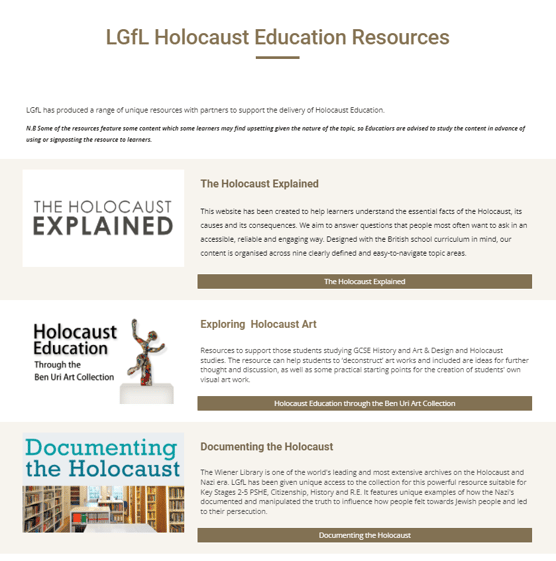
(N.B. Some of the resources feature some content which some learners may find upsetting, given the nature of the topic, so Educators are advised to study the content in advance of using or signposting the resource to learners)
Using this LGfL resource, whether through the secret transcripts of the M-Room, the visual testimonies of Holocaust Art, or the lived experiences of Kindertransportees, these resources are the tools we use to build our bridge. By engaging with these resources, we ensure that the distance of time does not lead to the erosion of truth.
This Holocaust Memorial Day, we invite you to use these materials to start a conversation, teach a lesson, or simply reflect. In doing so, you become a vital link in the chain of remembrance, ensuring that the history of the past continues to an informed future.
Other recommended (free) resources you can access:
Michael Rosen has recorded a series of powerful poems about his family's experiences during the Holocaust, which you can use to inspire your students.
A selection of resources based around "War and Peace" from the Literacy Shed. These would be worth watching, particularly if you are exploring a more comprehensive topic on war and peace (and not just HMD).
As teachers, it is vital that we continue to pay our respect to the victims of the Holocaust by continuing to sensitively pass on the memories of the past, and to try to prepare our pupils for a better future. We hope that our resources will support you with this important endeavour.
Listen to the audio version created using Notebook LM