

Crucially, the grassroots evidence shared at this event directly mirrors the core ambitions of the Department for Education’s (DfE) white paper policy aspirations, which focus heavily on excellent teaching for every child, high-impact standards, and robust targeted support to promote absolute inclusion.
Here is a look at the standout insights from the event and how they align with the national vision for the future of education.
True Inclusion: Normalising Support with 1-to-1 Devices
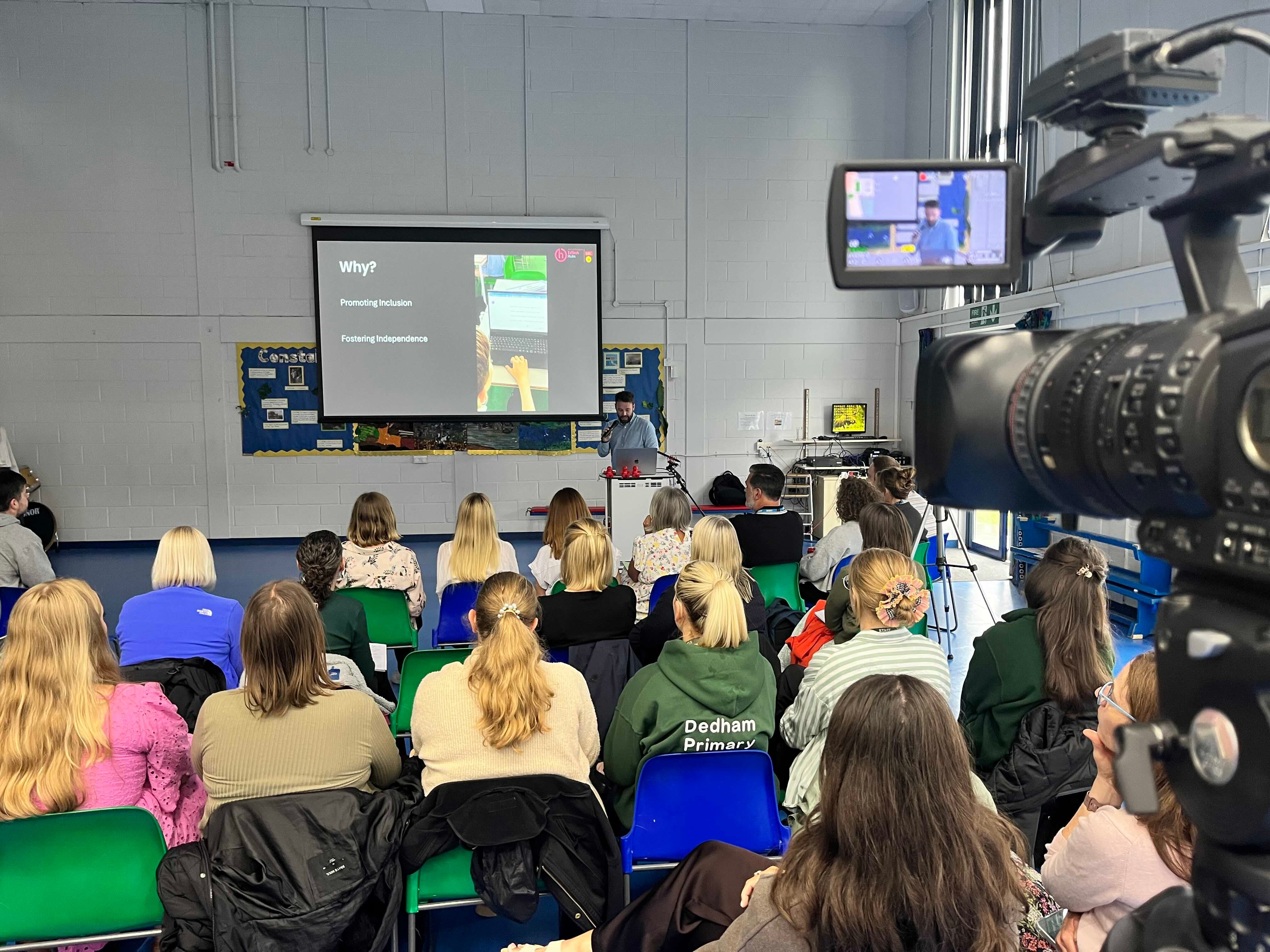
A key pillar of the DfE’s white paper is ensuring that children with Special Educational Needs and Disabilities (SEND) or those requiring targeted support thrive within mainstream settings. In his presentation, Ashley Page from Highfields Primary School in Manningtree demonstrated how a well-managed 1-to-1 laptop environment can break down learning barriers without making alternative provisions feel glaringly obvious.
By utilising Microsoft Teams as a central platform to host lesson slides, Ashley explained how tech naturally lowers cognitive load:
"Our key focus has sort of been inclusion in the class. Everyone has different needs. And hopefully with these one-to-one devices, we can then respond to those needs without making it obvious to everyone else"
By embedding standard tools like immersive readers, dictation, and live captions across all pupil devices, Highfields Primary has successfully normalised access to support. Pupils who require scaffolding can independently revisit concepts or watch explanatory videos right from their desks, enabling seamless adaptive teaching that leaves no child behind.
From Disengagement to Literacy: Scaling from Nothing
"I had two children... who were starting to become school refusers... They couldn't read, they couldn't write. But by using just something as simple as speech to text to help them with their writing, they went from not coming into school... to being] my most energetic writers by the end of the year, and that's why we use technology."
Chris Curry, Mayflower Primary
This directly hits the DfE's ambition to ensure children at risk of falling behind receive early, targeted interventions that draw them back into high-quality learning.
Immersive Curriculum: Spurring Ambition and Broadening Horizons
The white paper envisions a broad, engaging curriculum that prepares students for the digital economy. This was brought to life vividly in two presentations focusing on early years and Key Stage 1.
- Hooking Learners with Augmented Reality: Headteacher Tara Marshall from Highfields Primary illustrated how her school used Sandbox AR to bring dinosaurs to life on the school field. Rather than replacing traditional pedagogy, the technology acted as an active baseline stimulus. Tara noted that the immersive experience instantly transformed the young children into "investigators [and] journalists" who launched into highly sophisticated discussions about animal habitats and the reliability of digital evidence.
- Connecting Globally via QR Codes: Katie Crouch, also a Year 1 teacher at Highfields, shared how an exchange project with a school in Kenya evolved meaningfully through digital audio snippets made on Vocaroo. Her lively class scanned QR codes via iPads to hear directly from their overseas peers, sparking immersive language work, video creation, and presentation skills that significantly boosted parental engagement.
Reducing Teacher Workload through AI and Smart Assessment
The government’s ongoing focus on reducing teacher workload to boost staff retention and focus on quality delivery is heavily supported by modern AI tools.
Addressing this theme, Mark Vickers from The Royal Hospital School in Holbrook demonstrated the practical capability of specific generative AI agents. Focusing on Microsoft Copilot Chat, Mark highlighted the "Teach Agent" as an invaluable asset for curriculum planning, scaffolding, and modifying existing content to save teacher time:
"The teach agent allows you to do a variety of different things... You can also modify existing content. So changing reading levels, differentiating instructions, adding supporting examples, aligning to standards, and things like that."
On the maths front, Keighley Dabbs from Lawford C of E Primary School demonstrated a free tool called Maths Universe. By linking an iPad to the classroom computer, teachers can dynamically snap live photos of pupils' physical math work or manipulatives and put them straight on the screen. This simple, workflow-optimised digital whiteboard technique allows teachers to provide immediate live feedback and celebrate peer successes across the entire room without forcing children to crowd around a single static visualiser.
System Leadership: Developing the Next Generation of Cloud Champions
For digital progress to be sustainable across the UK, school leadership must build capacity within their own workforces. Katie Usher and Lauren Aldridge from Lawford C of E Primary School shared how they scaled up an ambitious geography curriculum using ESRI's Map Maker pilot programme across all key stages.
To sustain this across the entire teaching team, they introduced a double-layered structure of student and staff advocates:
- Digital Leaders: Year 5 and 6 pupils who undergo a rigorous application process to support teachers during tricky technical moments in lessons, cultivating remarkable independence.
- Cloud Champions: Internal members of staff who team-teach and offer bespoke CPD to help colleagues take pedagogical risks and confidently embed technology safely.
The Takeaway for Educators
As Bob Usher, the EdTech Hubs programme lead from LGfL, reassures us at the start of the seminar, schools are all at highly varied points on their digital pathways:
"We're an eclectic mix of schools. We're all at different stages of development. That's absolutely fine. This is not about comparison. This is about inspiration."
The key lesson from this East of England cohort is that technology shouldn't seek to replace the teacher. Whether you are creating automated lesson resources with AI, connecting with schools globally via audio codes, or establishing cross-classroom laptop accessibility, the ultimate goal of PedTech is to enhance human connections and deliver a world-class education for every child.
All the presentations from the event can be viewed at the Pizza and PedTech event page
Keen to explore the wider platform of implementation plans, virtual classrooms, and school case studies? Visit the official LGfL EdTech Hubs Portal for access to further toolkits and advice.
About the EdTech Hubs programmeAt its core, the LGfL EdTech Hubs programme is a school-led network—co-managed in partnership with EdTech UK—that champions impactful "PedTech" (pedagogy-first technology) across UK classrooms. Bringing together schools at all stages of their digital journeys, the programme shares honest blueprints, trials, and successes to support purposeful 1-to-1 device deployment, workload reduction, and true digital inclusion. Through practical CPD and peer mentorship, it acts as a launchpad to move students away from passive screen consumption and toward high-impact digital creation. To explore virtual classrooms and launch your own digital strategies, visit the official LGfL EdTech Hubs Portal for toolkits and expert advice. |